Showing posts with label content restriction. Show all posts

Tuesday, July 2, 2002

Council loosens stance on signs: Rules on banners, flyers likely to ease

Chapel Hill Herald
Tuesday July 02, 2002
By RAY GRONBERG
Page 1


CHAPEL HILL - A shakeup of Chapel Hill's rules on flyers and political signs is likely after the Town Council gets back from its summer recess.

Council members have tentatively endorsed an ordinance that would do away with a restriction on the number of campaign signs on private property, and a time limit on their display.

The 5-4 decision also would loosen a size restriction that applies to temporary banners, like the one that provoked last September's "woe to our enemies" flap between town officials and a Franklin Street restaurant owner.

The narrow margin of the vote means that council members will have to hold a second ballot on the ordinance when they reconvene in late August, but passage seems assured.

"There are arguments that limiting speech in that way, as far as political signs go, is unconstitutional," said Mark Kleinschmidt, one of the council members who voted for the change. "Even if it's not, I don't think it's necessary that we regulate that to the full extent of our power."

Kleinschmidt and five of his colleagues also joined forces last week to instruct Town Manager Cal Horton to prepare a second ordinance that would do away with Chapel Hill's ban on attaching flyers to phone and light poles.

The move answered a West Rosemary Street record-store owner, Erik Ose, who sought the ban's repeal after police ticketed him in April for putting up flyers that advertised a "banquet for global peace and justice."

The repeal ordinance should be ready after the council's summer break and will include a provision that allows the Public Works Department to strip flyers off poles up to once a week.

The twin votes capped several months of debate about the town's sign rules that began when zoning inspectors made restaurant owner Scott Maitland take down the "woe to our enemies" banner.

Maitland's banner ran afoul of the town's existing regulation because it was four times larger than allowed.

But the removal triggered complaints because the banner's wording - which voiced Maitland's reaction to the Sept. 11 terrorist attacks on New York and Washington - had drawn objections from a trio of council members who thought it too bellicose.

A subsequent review by administrators found that some of the rules were too strict to survive a court challenge.

The limit on the number of campaign signs a resident can post on private property clearly fell into that category, as the town was only allowing one. The federal appeals court that hears cases from North Carolina has said a two-sign limit is unconstitutional.

Officials also had doubts about the time limit that applies to campaign signs. The town currently allows them to go up 30 days before an election and requires that they be taken down within seven days after voting.

The upcoming change would waive those restrictions entirely for signs on private property and loosen them for postings on the public right of way. The new right of way limits would allow postings 45 days before an election and up to 12 days after one.

Ose's repeal request arrived after the ordinance review was under way, and targeted a section of the town code that hadn't gotten council scrutiny until he spoke up.

The flyer ban applies to any posting, whether it advertises a business or a political viewpoint.

A trio of council members - Flicka Bateman, Pat Evans and Jim Ward - voted against both proposals last week. Mayor Kevin Foy joined them in voting against the changes to the rules on campaign signs.

Bateman and Ward indicated that they had more objections to repealing the flyer ban. They and Evans noted that light poles are private property, which makes attaching flyers to them a form of trespassing.

Evans and Bateman added that flyers would only mean more visual clutter and litter on the town's streets, especially if they proliferate after the ban's repeal.

"Some people think this is only going to be the downtown, and it's not, it's going to be throughout the town," Evans said. "There's the possibility that some very offensive signs could be put up because there's no regulating them at all. And I don't know how we could possibly afford to take them down each week throughout the community."

Bateman agreed.

"People have made such a big thing about the entryways into Chapel Hill, but there are utility poles that line the entryways into Chapel Hill," she said. "And that would be a great place to advertise everything from 'free haircuts' to 'Viva Castro.' "

But Kleinschmidt said the town barely enforces the existing restrictions, a stance that undercuts the rule of law.

"It basically distills down into government giving citizens a message that 'we're in control and don't you forget about it,' " he said. "I don't think that's good policy. If we have laws on the books that aren't being enforced, we need to change them."

Saturday, April 13, 2002

Store owner challenges ban on flyers: Utility pole law impedes free speech rights, he says


Chapel Hill Herald
Saturday April 13, 2002
Page 1
By RAY GRONBERG


CHAPEL HILL - A West Rosemary Street record store owner wants the Town Council to repeal Chapel Hill's oft-ignored ban on posting flyers and signs on telephone poles.

Erik Ose says the 41-year-old law is an impediment to free speech that harms political groups and small businesses that can't afford newspaper and broadcast advertising.

Efforts to enforce the ban are a waste of money and undercut Chapel Hill's college-town image, he adds.

"It is a judgment call, but, personally, I feel a telephone pole covered with colorful, exciting, diverse posters looks better than cold, barren poles covered with staples and jagged pieces of paper," Ose said. "That's the kind of Chapel Hill I want to live in, not one where posters are treated like a scourge to be torn down and destroyed."

Ose appeared before the Town Council on Monday to ask members to consider a repeal measure and has since launched a petition drive to gather public support. He said more than 200 people have signed.

Council members relayed Ose's request to Town Manager Cal Horton, who will report back with research and advice later this spring.

Ose launched his repeal drive after a Chapel Hill police sergeant ticketed him on April 4 for attaching a flyer to a pole near the Franklin Street post office.

The flyer advertised a "banquet for global peace and justice" later that night in Carrboro that ended up raising $2,500 for a variety of social justice causes, said Ose, who runs Lost City Music & Video.

A police officer saw Ose stapling a flyer to the pole and asked him to take it down. Ose refused.

"I said I was sorry, I couldn't do that, because I didn't think it was a just ordinance," he recalled.

The officer summoned his sergeant, Anthony Brooks, who issued the ticket when Ose again refused to remove the flyer. The ticket charged him with placing a sign or notice on a utility pole in violation of a city ordinance.

It was referring to section 16-3 of the Town Code, which says "no signs or notices for advertising purposes shall be fastened or tacked to telephone, telegraph or electric light poles or trees on the streets or sidewalks."

Both officers were courteous, professional and surprised that someone was willing to spend time fighting the ordinance, said Ose, who added that he intends to contest the ticket in court on May 20.

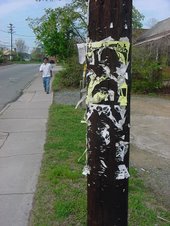
The flyer ban is one of the most widely flouted ordinances in town, as a glance at any phone pole along Franklin and Rosemary streets would show. Ose is among the dozens of people who post announcements on them each day.

Many advertise political causes, but others promote businesses and concerts.

Town officials are just as energetic about removing them. The Public Works Department dispatches a landscaper each Sunday to strip flyers from phone poles and kiosks.

Postings in the kiosks are legal.

"We'd much rather that they be put there than stuck up on telephone poles or buildings," said Harv Howard, solid-waste services superintendent, who added that removal drives also precede major weekend events and festivals.

The town ordinarily maintains five kiosks, but it's been getting by with a couple less in recent years. Crews removed them during Streetscape sidewalk work.

Officials do intend to replace them - and the wooden kiosks that still remain elsewhere along Franklin Street - with steel-framed models designed to look better and stand up to vandals.

A public works crew will install the first steel kiosk next week on North Columbia Street, said Curtis Brooks, the town's urban forester.

The steel kiosks are being built by a Durham fabricator who charged the town $950 for the first one.

"If, as we anticipate, people feel it's an improvement over the older ones, we'll go ahead with the other five," Brooks said.

But while Ose said more kiosks are welcome, he still thinks the council should repeal the flier ban.

"The utility poles exist," he said. "What else are they really used for? They're a natural venue for free speech."

Ose's challenge to the flyer ban comes as officials are considering changes to another section of town law that also regulates signs.

The review - and a parallel enforcement suspension - began following September's "Woe to Our Enemies" flap involving East Franklin Street restaurant owner Scott Maitland and the town's Inspections Department.

Inspectors made Maitland take down a banner expressing his views on the Sept. 11 terrorist attacks.

They said it was too large, but the order drew fierce protests because it came while three council members were in the process of complaining to Horton about the banner's message.

Officials subsequently agreed that parts of the sign law are vulnerable to challenge, and are in the process of scheduling a hearing to gather advice on how to change it.

The president of the American Civil Liberties Union's Chapel Hill-Carrboro chapter, Mark Dorosin, said the flyer ban might raise similar issues.

While court cases say local governments can impose reasonable "time, place and manner" restrictions on speech, they frown on any attempt to regulate content.

Since the flyer ban refers specifically to advertising, its wording could signal a content restriction, Dorosin said.

The code has one other potential problem, because it allows Horton to waive the posting ban for "temporary signs."

"What does that mean, and what is he basing that exercise of discretion on? If it's content based, it's constitutionally suspect," Dorosin said. "Anything that creates a content-based restriction, where the problem is the message rather than the form the message is being delivered in, I would say creates First Amendment problems at the least."