Showing posts with label art. Show all posts

Monday, April 2, 2007

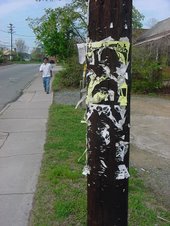
WHY ARE POSTERS A CRIME IN CHAPEL HILL?


Chapel Hill Ordinance Sec. 16-3 (Placing notices, signs on
utility poles, trees, prohibited; exception.) No signs or notices for advertising purposes shall be fastened or tacked to telephone, telegraph or electric light poles or trees on the streets or sidewalks. However, the town manager may give permission for temporary signs to be placed on the streets or poles. (Comp. 1961, p. 44, § 3; Comp. 1961, pp. 51, 54)


In 2002, after a local activist was detained, cited, found guilty and fined after posting flyers on Franklin Street for a Banquet for Global Peace and Justice being held in Carrboro, more than 1,200 citizens of Chapel Hill petitioned the Chapel Hill Town Council to repeal this misguided ordinance. The Chapel Hill Herald editorialized against the ban, and the Town Planning Board recommended that it be repealed.

In the end, the Town Council voted 6-3 to keep the ban (Council members Mark Kleinschmidt, Bill Strom and Ed Harrison were the only three members to oppose the ban, while Pat Evans, Flicka Bateman, Edith Wiggins, Dorothy Verkerk, Jim Ward, and Mayor Kevin Foy voted to keep it). Five years later, new council members have been elected, but the issue hasn't been revisited and the ban still stands.

In our own ways, we are all artists. As the Chapel Hill Herald pointed out, "the poles are used by dozens of people each day to let the community know about a concert, an apartment to rent or even a banquet for peace and justice" (CH Herald editorial, April 18, 2002). A law like this is contrary to the tolerance and free exchange of ideas that makes Chapel Hill such a special place. If you think we should be able to hang posters on telephone poles without fear of arrest, sign the on-line petition!

"We, the undersigned, request that the Chapel Hill Town Council revise or repeal Chapel Hill Ordinance Sec. 16-3 to allow the posting of signs or notices for advertising purposes on utility poles, in order to encourage free speech, artistic expression, and grassroots marketing by local businesses."


CLICK HERE TO SIGN THE ON-LINE PETITION!


Sunday, April 1, 2007

Mr. Jazzy, Killer, Sonny Boy, and Mr. Crazy say FREE THE TELEPHONE POLES!

Just this spring, art appeared on telephone poles around town. Hand painted wooden signs were nailed to poles featuring "lost" animals - Mr. Jazzy, Killer, Sonny Boy, and Mr. Crazy. "A little guerrilla art in Chapel Hill," said Kate Flory, executive director of the Chapel Hill Public Arts Commission. "That's fun." Unfortunately, as the law now stands, IT'S ALSO ILLEGAL.

Local mom finds 'lost' art
Chapel Hill News
March 21, 2007
By Mark Schultz
Page 1

CHAPEL HILL -- Sandra Elliott has started collecting art.

But the Chapel Hill interior designer says she'll gladly put the art back where she found it if the artist wants her to.

Elliott was on Elliott Road about a month ago when she saw the first one: the word "Lost" and a crudely painted dog on a hand-sized piece of wood nailed to a utility pole.

Her son, Blake, yelled at her when she pried the piece of wood from the pole.

"Mom, you took the sign down," said Blake, 12. "What if somebody is trying to find their dog?"

"Well, there's no phone number," she replied. "And I don't think any dog looks like this."

The dog on the wooden board had five orange stripes down its back.

So far Elliott has collected four "Lost" signs looking for creatures named Mr. Crazy, Killer, Sonny Boy and Mr. Jazzy.

"I have not heard of this," said Kate Flory, executive director of the Chapel Hill Public Arts Commission. "A little guerilla art in Chapel Hill. That's fun."

In addition to Elliott Road, Elliott said she has found the signs on South Lakeshore Drive, old Erwin Road and Old Chapel Hill Road.

"It's become our hunt," Elliott said of her turns driving in Blake's school carpool.

But she doesn't want to keep the art if its creator didn't intend for people to take it.

"I'm enjoying this, but I don't want to look like I'm going around stealing things," she said.

Friday, May 12, 2000

Stop and smell the posters

Ron Liberti, "Self-portrait"
The Chapel Hill News
May 12, 2000
By Marisa Brickman
Page B4


There's this poster hanging on kiosks and telephone poles that's been catching my eye for the past two weeks. Every time I pass the poster, I want to rip it down and take it home with me. The poster is tall and skinny, blue and white and has a really cute image of two little girls sharing a secret about a Three Stigmata show. Have you seen it?

Some people think posters are litter and others think they're art. I'm on the art tip. There is definitely a separation between an ugly advertisement and an aesthetically pleasing flyer.

I think we'd all agree that the mass-produced neon 8-by-10s posted anywhere and everywhere are eyesores. However, the screen-printed posters selectively placed in store windows and on the few remaining kiosks do nothing but beautify the city and make you do a double-take.

Screen-printing posters for rock shows has long been part of music scenes everywhere from San Francisco to Seattle to Chapel Hill. It makes sense because many accomplished musicians are also talented visual artists.

"Most of the people I know that screen-print have been in bands at some point; it tends to go hand in hand," said Casey Burns who has been screen-printing for the past nine years.

A lot of musicians screen-print their own posters. They understand their music and can most accurately represent their band's sound in a visual way.

Ron Liberti, who used to rate rock-show posters in a column for the 'zine Trash, has been screen-printing since 1988. He made them all when he played guitar with Pipe, and now he does all of the posters for his current band, Clok-Lok.

"The ones that people made with their own hands seem to lend more importance to the show and make it more of an occasion," he said. "Shows are important, and I try to put as much love and care into the posters as I do into the music."

One can only print so many posters, and the fancier they are, the more likely people will want them for their own. Just go visit the home of any local show-goer and you will most likely find at least one screen-printed show poster plastered on the wall and displayed as a piece of art.

Eric Cope, drummer for Three Stigmata and Hunter Gather, started screen-printing last summer, and his efforts have been nothing short of prolific.

"Screen-printed posters are better than photocopies because there's more love put into it. It's like a miniature painting - if someone sees it, they take it off a pole as a memento. Plus, it's a good way to remember a good show."

In order to promote a show, you almost need both. Photocopies aren't as pretty, but they help get the word out. And if everyone is taking the screen-prints home for souvenirs, double-teaming the promotion efforts have to help.

"The nicer looking ones get taken fast," said Burns. "It's a nice compliment, but you also want people to know about it, so I usually also make photocopies."

The areas where flyers may be placed have consistently dwindled over the past few years, leaving less and less space for legal flyering.

"In the seven years I've lived here, they put up kiosks as a solution to the problem of posters on telephone polls as sort of a compromise between rockers and city council," said Burns. "Since I've lived here I've seen a few of them disappear. There's only two or three now."

While most screen-printers seem to know the rules (no telephone poles or utility boxes), posters still appear almost any place they can be stapled. With the barrage of posters all concentrated in a few places, it drives the artist to seek out alternatives.

"I think your opportunities are limited only if you play by the rules. You shouldn't put them on anything alive, like trees, but if it's dead it's OK," said Liberti.

"People should be more original about where they put them," he added. "I once saw a flyer for a show in the beer cooler at Harris Teeter."

Other than the rules set out by the town of Chapel Hill, there seems to be a set of unwritten laws that respectable flyer posters abide by. When stapling up posters, it's important to check the date before you cover up someone else's hard work. And if you wallpaper kiosks with repetitive self-promoting propaganda, you'll do nothing but give yourself a bad reputation. That's not art, anyway.

Most people forget that art can be functional and aesthetically pleasing at the same time. If you haven't stopped to smell the posters, you should take the time to enjoy their visual pleasure before someone takes it home and puts it up in their kitchen.