Showing posts with label aesthetics. Show all posts

Friday, November 15, 2002

Council keeps ban on utility pole flyers


Chapel Hill Herald
Friday November 15, 2002
BY RAY GRONBERG
Page 1


CHAPEL HILL - Despite the pleas of a Rosemary Street record store owner, the Town Council has decided to retain Chapel Hill's longtime ban on posting advertising flyers on utility poles.

A divided council voted 6-3 earlier this week to retain the ban. Members who favored retaining the ban said it's consistent with the town's desire to maintain a clean downtown.

"I'm looking for consistency," said Councilwoman Flicka Bateman, who noted that the next edition of Chapel Hill's land-use law might limit Duke Power's ability to install overhead utility wires.

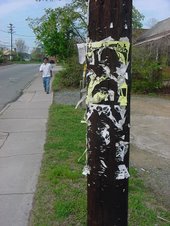
Concern about aesthetics is driving that decision, so it makes no sense to "allow the cluttering of utility poles at eye level" at the same time, she said.

The three dissenters - Councilmen Ed Harrison, Mark Kleinschmidt and Bill Strom - wanted to repeal or significantly modify the ordinance.

Kleinschmidt and Strom argued that the presence of flyers on utility poles is a common feature of life in a college town.

"It boils down to a subjective aesthetic," Strom said. "A creosote-coated, pressure-treated piece of lumber with 9 million staples in it is aesthetically unappealing [too]."

The council opened debate on the flyer ban this spring, at the request of Erik Ose, the owner of Lost City Music & Video on West Rosemary Street.

Ose asked the council to consider repealing the ban after he received a ticket for attaching a flyer advertising a "banquet for global peace and justice" to a pole.

A police officer who saw Ose put up the flyer issued the ticket after the record store owner refused an order to take it down. The ticket eventually cost Ose $115.

Ose criticized the council's decision to retain the ban on flyers.

"Most people are flabbergasted to learn that this law exists to begin with," he said. "All we're asking is that they let people's posters stay up for a week at a time, which would save the town money, encourage low-cost marketing by locally owned businesses and grass-roots political expression, and preserve the sense of community that flyers and posters give our town. Would that be so terrible?"

Roughly 1,200 people signed a petition organized by Ose that favored repeal. But a key player - Duke Power - weighed in strongly against the proposal.

Duke officials argued that the heavy staples used to attach flyers cause wood to erode over time, and create safety hazards for workers who have to climb poles to maintain utility lines.

Duke, BellSouth and Time Warner Cable own most of the poles in town. The poles are private property, and some critics of the repeal proposal argued that it amounted to the legalization of trespassing.

Ose saw it differently. "I'd like to think that the voices and wishes of the community speak louder than a big corporation when it comes to deciding town issues," he said.

Meanwhile, Mayor Kevin Foy noted that the town is in the process of rendering the debate moot. It's already asked Duke to replace the wooden poles now in place along North Columbia Street and the 100 block of East Franklin Street with metal fixtures that jibe with the requirements of Chapel Hill's Streetscape program.

Monday's vote also ordered Town Manager Cal Horton and his staff to look for additional places to install the four-sided flier kiosks that are part of the Streetscape program.

Wednesday, October 16, 2002

1200 signatures total from residents of Chapel Hill on petition to repeal poster ban

Statement to Chapel Hill Town Council, 10/16/02

Good evening, Mayor Foy and members of the Council.

My name is Erik Ose, and I first came before you a last spring with a petition to allow the posting of notices on utility poles in Chapel Hill.

I see this issue is one of the items before the Council at tonight's public hearing, so I wanted to come back before you and present another 200 signatures on this petition. This makes a total of 1,200 Chapel Hill residents who have signed, which hopefully demonstrates that however minor this issue might seem in the global scheme of things, it's still a local issue that a great number of town citizens care deeply about. It speaks directly to what kind of town we all want Chapel Hill to be.

The ordinance that first prohibited signs or notices for advertising purposes from being placed on utility poles dates from April 7, 1925.

Maybe this ordinance made sense for Chapel Hill when it was still a small village back in 1925. It probably seemed like a progressive law, a way to keep local businesses from littering the town’s landscape with excessive commercial appeals. But there are important differences between the Chapel Hill of 1925 and today. In 2002, if you’re putting a flyer up on a telephone pole, more than likely, it’s advertising a concert, or it’s about a political issue, or you’re a small business, a locally owned business without a huge advertising budget. Local businesses like C.O. Copies, Back Door CD’s, Carolina Car Wash, Internationalist Books, and the Burrito Bunker use flyers all the time to attract customers.

These stores are trying every day to compete with faceless chain stores in our town owned by national corporations, the kind of economic competition that didn’t exist in Chapel Hill 77 years ago. I think the town needs to do all it can to encourage, not discourage locally owned businesses to stay open in Chapel Hill.

Obviously, even more disturbing is that you're subject to arrest if a police officer catches you in the act of posting a flyer. I don't think our town should be spending its limited resources criminalizing the simple act of its residents putting posters on telephone poles.

I know Duke Power would like to keep this ordinance as its now written, because the town is spending our tax dollars to keep their poles clean. I would think a utility like Duke Power would want to give something back to the community in which they operate by letting the citizens of Chapel Hill use the utility poles to post notices. They say the poles don't last as long if people put posters on them. What, are they going to fall over once they accumulate a critical mass of staples?

And the argument about how staples jeopardize the safety of linemen seems to be a red herring, because most linemen these days don't climb poles, they go up in cherrypickers, and if Duke Power is truly concerned about their workers' safety, they should be willing to spend the extra money to let them go up in cherrypickers if there's a problem with the poles.

I’d also briefly like to address the aesthetic argument against posters. If this ordinance is designed to improve the town’s appearance by keeping utility poles bare, then it’s accomplishing exactly the opposite of what it was intended to do.

Take a look at any one of the utility poles downtown located at major intersections. What looks better, a cold, barren pole littered with jagged, torn scraps of paper, or one covered with colorful, exciting posters representing the free exchange of ideas that’s so central to the very idea of what Chapel Hill is about? That’s obviously an aesthetic judgement call. But the reality is that when the town spends taxpayer money to tear down people’s posters every single day, the posters are going to look like eyesores. Look at the poles. They’re covered with staples and remnants of posters. Citizens put posters up on utility poles every day, and they’re going to keep doing it, unless there’s a cop on every corner ready to arrest them. So the poles are going to look like eyesores unless the Council revises this ordinance.

Right now the public works department spends taxpayer dollars to tear peoples’ posters down daily. Wouldn’t it make more sense and save some money by having them do it just a little less often, maybe once a week, like they clear the town-owned kiosks on Sunday mornings. That way, people’s posters would have a chance to be seen without being immediately torn down, and the poles would look more aesthetically pleasing all week long. But again, that’s just my aesthetic judgement call. The most important thing is for the town to start placing value on its citizens being able to freely express ourselves.

Some people might say that by virtue of the town maintaining several kiosks in the downtown area where flyers can legally be posted, the town has every right to declare utility poles off limits to public posting. Over the summer, more kiosks have been constructed as part of the town's Streetscepe improvement program. That’s great, more kiosks are certainly welcome. But the utility poles exist, they’re not being used for anything else, they’re a natural venue for free speech. More kiosks cost more money, but it would actually cost the town less money to clear the utility poles weekly instead of daily if this ordinance is revised.

Besides, I think the Council needs to take a hard look at whether speech in town is truly free if it’s restricted to only certain little areas. On any given day in Chapel Hill, people are on the move, going about their daily lives, and not necessarily stopping by the town-owned poster kiosks for their daily appointment with free speech. Bottom line, that’s why people put flyers on utility poles, because it’s where their messages have a realistic chance of being seen and heard.

I know this Council has the town's best interests at heart, and when deciding this issue, I know the Council will consider what is the right thing to do, the progressive thing to do, the Chapel Hill thing to do. Thank you.

Monday, June 24, 2002

1000 signatures from residents of Chapel Hill on petition to repeal poster ban

Statement to Chapel Hill Town Council, 6/24/02

Good evening, Mayor Foy and members of the Council.

My name is Erik Ose, and I first came before you a couple of months ago with a petition to allow the posting of notices on utility poles in Chapel Hill.

I see the Council is scheduled to discuss this issue tonight, so I wanted to come back before you and present another 100 signatures on this petition, in addition to the 900 I delivered to you last month. This makes a total of 1,000 Chapel Hill residents who have signed this petition, which hopefully demonstrates that however minor this issue might seem in the global scheme of things, it's still a local issue that a great number of town citizens care deeply about. It speaks directly to what kind of town we all want Chapel Hill to be.

In the couple of months since you first received this petition, the town has constructed three new kiosks on Franklin Street where postings are allowed. Numerous people have commented to me that they guess the construction of these kiosks represents the town's response to our petition. I've responded that I'm sure the kiosks were already scheduled to be built as part of the town's Streetscape improvements, and are unrelated to the timing of this petition. I certainly hope that the Council will not turn to these new kiosks as the only solution.

More kiosks are welcome, but they cost money that the town can ill afford at a time of widespread budget cuts. In contrast, telephone poles already exist, they're all over town, not just in the downtown area, and it would actually cost the town less instead of more to allow citizens to post notices on them, because now the Public Works Department spends tax dollars clearing the poles more often than they clear the kiosks. Clearing the poles once a week makes much more sense, would cost the town less, and give people's messages a chance to be seen and heard.

Bottom line, the town shouldn't be spending its limited resources criminalizing the simple act of its residents putting posters on telephone poles. Thank you.